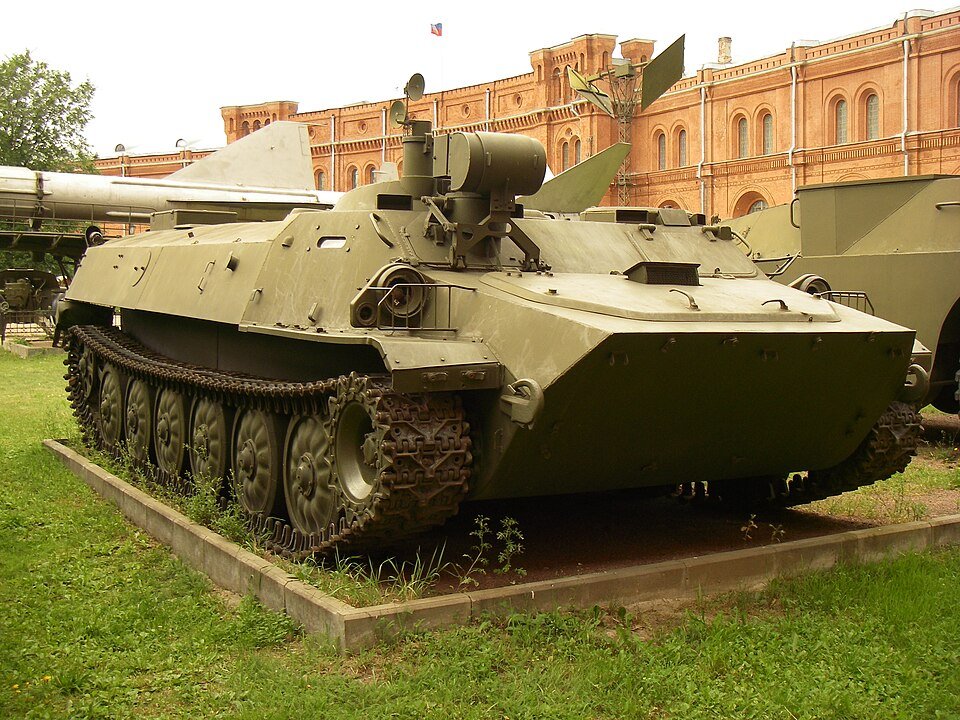
The Russian Army’s Insatiable Hunger for Armor: The Shturm-S Returns from the Graveyard—But as a Transporter
Russia, December 18, 2025 – The Russian Army is once again reaching deep into Soviet stockpiles. Satellite images suggest that after years of inactivity, the renovation of the now legendary 9P149 Shturm-S tank destroyers has resumed. This time, however, it is not about returning the old anti-tank weapon to the front line. Russia is converting these vehicles back into MT-LB armored personnel carriers, or using them as the basis for other improvised weapon platforms.
It is a clear signal. Moscow is facing an acute shortage of armored vehicles, caused by huge losses in Ukraine and limited industrial capacity. And the Shturm-S, a design from the 1970s, has become yet another example of an effort to fill the gaps at all costs, even if it means transforming long-deprecated vehicles into something completely different from what they originally were.
Despite being an outdated system with limited combat value, Russian industry now sees it as a source of something much more valuable. MT-LB chassis that can be quickly modified, armed or filled with infantry and sent to the front. The once specialized anti-tank vehicle is thus becoming a symbol of the current reality of the Russian arms industry – improvisation, recycling and maximization of what is left.
What is the Shturm-S? A return to the era of Soviet anti-tank “hunters”
To understand why Russia began converting the legendary Shturm-S into personnel carriers, it is necessary to return to what this machine actually is. The 9P149 Shturm-S was created in the late 1970s, when the Soviet Union was looking for a means of destroying then-modern Western tanks at a distance of several kilometers. The answer was a self-propelled missile complex based on the versatile MT-LB tracked vehicle.
At first glance, a simple machine. It looks like a regular transporter, but instead of a landing area, there is a rotating magazine with 12 9M114 Sturm guided missiles. One missile is always ready on a retractable launch pad. After firing, the system automatically throws away the empty container and inserts another. For its time, it was a relatively sophisticated solution. The missiles had a range of 400 to 5,000 meters, a speed of around 350–400 m/s, and were capable of penetrating 550–600 mm of armor. In the 1980s, this was more than enough for most NATO tanks of the time. The power unit was a 240-horsepower YaMZ-238 diesel engine, which gave the machine a speed of up to 61 km/h on the road. In the Cold War era, it was a decent machine. Today, however, it is a technology that has found itself on a battlefield where drones, precision ammunition and thermal imaging dominate, and in this environment, the Sturm-S is having a hard time surviving.
The Sturm-S suffers from several fundamental shortcomings. It does not have a “fire and forget” mode, the operator must guide the missile to the target all the time. Low modernization range and low resistance to interference. The MT-LB as the basic chassis has very thin armor. High vulnerability to FPV drones and close artillery fire. On the Ukrainian front, crews often risk more than the benefit of deploying the system. That is why Russia began to consider what to do with the system next. The answer was not its modernization, but cannibalization into transporters.
Why Russia is bringing old technology back into play
The basic motivation is the dramatic shortage of MT-LBs, universal transporters that serve on the front to transport infantry and as platforms for various weapon systems. Russia has restored about 3,500 MT-LBs from storage in recent months. Still, it is not enough, Russia’s losses are too high. Oryx records at least 1,119 MT-LBs destroyed, 78 abandoned, and 147 captured by Ukrainian forces, including dozens of upgraded MT-LBVM and MT-LBVMK versions.
At the same time, the Russian defense sector is unable to produce enough new equipment. Factories like Uralvagonzavod are overloaded. According to leaked documents, it is to produce and upgrade over 1,100 T-90M2 “Ryvok-1” tanks between 2027 and 2029, with plans extending to 2036. In practice, this means that the capacity for the production of other types of armored vehicles is limited, and the actual renewal of the personnel carrier fleet is therefore based mainly on the renovation of old Soviet chassis.
Therefore, a step is being taken that would not normally make sense: the Shturm-S is not being upgraded to a more modern anti-tank variant, although theoretically there is a possibility of increasing its capabilities to the standard with 9M120 Ataka missiles. However, this option is unlikely, since Russia now relies on much newer systems, such as the 9P157-2 Chrysantema-S or 9P163-1 Kornet-T. These are common on the battlefield, while the Shturm-S has proven to be extremely vulnerable.
Why Russia Needs It Again Today
The interest that Russian industry is showing in the old Shturm-S in 2024 and 2025 certainly does not stem from their original purpose or combat value. Today’s Ukrainian battlefield is full of unmanned vehicles, precision artillery systems and reconnaissance drones, which makes slow and lightly armored machines of this type extremely vulnerable. Moreover, the 9M114 Shturm missiles themselves and their modernized version 9M120 Ataka are still usable, but far from representing the top of modern anti-tank weapons. All this would indicate that the Shturm-S should remain permanently stored in several storage facilities.
But Russia needs it again, not because of the guided missiles, but because of its chassis. The MT-LB, on which the Shturm-S is based, is today one of the most sought-after types of armored vehicles in the Russian army. It is a simple, lightweight, easily repairable carrier that can be equipped with almost anything: a machine gun, an anti-aircraft twin cannon, an improvised rocket weapon, an anti-tank guided system, or even just to transport infantry or ammunition. And that is the main motive. Russian losses are so extensive that it does not matter whether the base is 40 or 50 years old. What is important is that it is available.
Signals from Russian social networks and open source monitoring show that the revival of the Sturm-S is not an isolated episode. Mobilization of old machines, whether modernized or rebuilt, has become a fixed part of the Russian strategy to replace losses. It is not certain whether Russia will retain some of the vehicles in their original role as anti-tank carriers, or whether all the chassis will be returned to the form of personnel carriers.
Peter North