What rocket launchers does Excalibur Army offer? Due to the lack of interest from the Czech Army, it must look towards foreign markets
Czech, December 31, 2025 – Today, Excalibur Army is one of the most important Czech manufacturers of artillery equipment. Its portfolio includes self-propelled howitzers and rocket launchers that combine traditional Central European design schools with modern electronics, automation and digital fire control. Although this is a technology created on Czech chassis, with a significant share of domestic industry, it finds its application mainly abroad.
While self-propelled howitzers have come to the center of attention of the Army of the Czech Republic in recent years, rocket artillery has long remained outside the main acquisition stream. The result is a paradoxical situation: the Czech manufacturer offers a comprehensive range of modernized and new rocket launcher systems, but their natural customers are not domestic armed forces, but armies abroad.
Excalibur Army’s approach to rocket launcher systems can be characterized as evolutionary, not revolutionary. Its offer is not based on completely new designs, but on the proven RM-70 and BM-21 systems, which for decades were the backbone of the rocket artillery of the Warsaw Pact countries and many other states.
Instead of trying to replace these weapons, the company has chosen a strategy of their deep modernization. This includes the installation of new chassis, primarily the Tatra brand, a significant increase in mobility and reliability. The introduction of digital fire control and automatic aiming. And finally, reducing the time required to start and stop firing.
Thanks to this approach, the Excalibur Army rocket launchers are attractive especially to users who already have stocks of 122 mm ammunition and have experience with the operation of the original Soviet systems. Modernization allows them to maintain logistical continuity and at the same time significantly increase the combat value of the equipment.
At the same time, however, the company also offers variants that, with their parameters and level of automation, are aimed at customers demanding full-fledged modern MLRS, capable of operating in a networked environment and meeting alliance standards. The common denominator of the entire offer is the emphasis on mobility, ease of operation and speed of the firing cycle – i.e. properties that are decisive in the current war.
Rocket launcher portfolio
The Excalibur Army rocket launcher offer is designed to cover a wide range of users – from armies striving to acquire modern rocket artillery to states looking for a way to effectively extend the life of their existing equipment. The common feature of all systems is the retention of the 122 mm caliber, which remains one of the most widespread worldwide, and the emphasis on mobility, speed of deployment and automation of fire.
RM-70 VAMPIRE 4D (8×8) The most modern rocket launcher in the offer
The RM-70 VAMPIRE 4D represents the technological pinnacle of the Excalibur Army rocket launcher offer. It is a deeply modernized system based on the original RM-70, but mounted on the new Tatra T815-7 chassis with an 8×8 configuration. This chassis significantly increases the cross-country ability, speed of movement and overall reliability of the system.
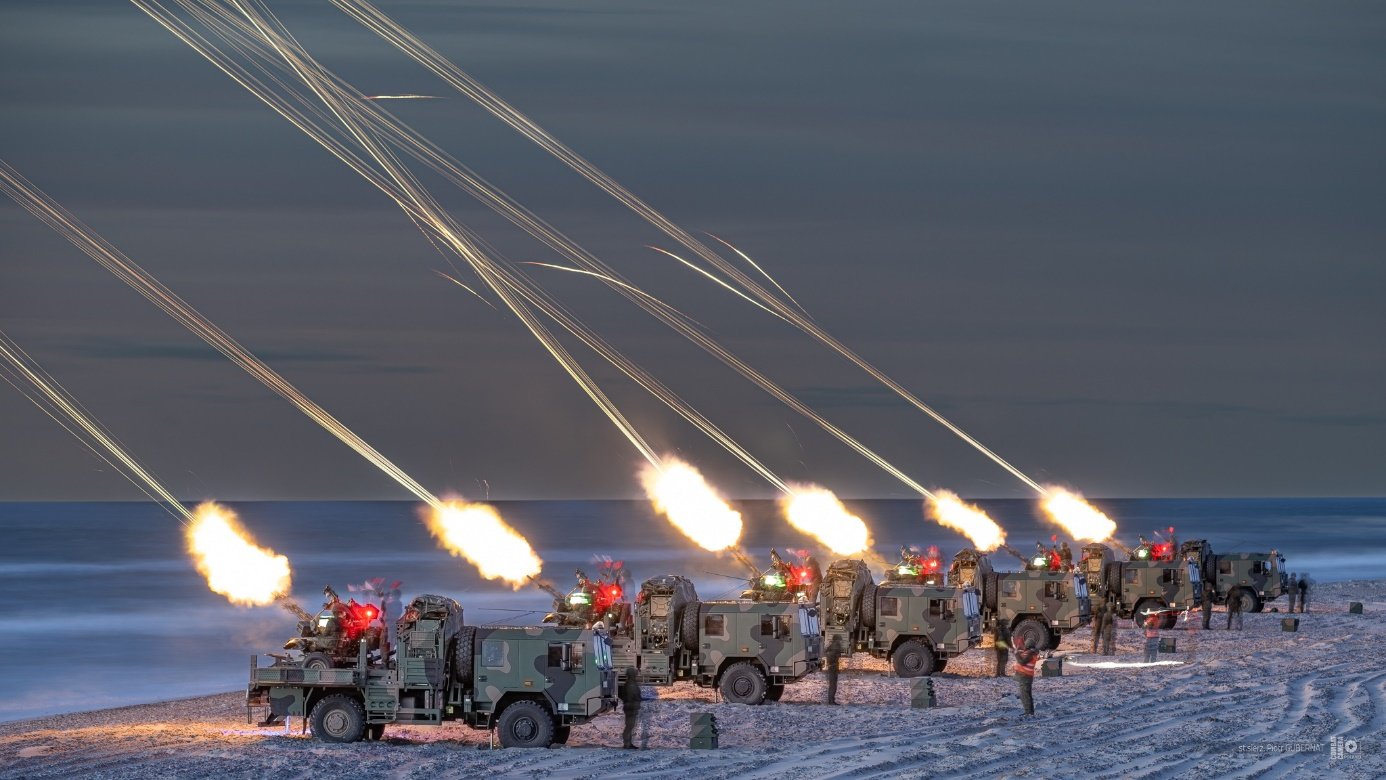
The key element is a fully digital fire control system, which allows automatic aiming, calculation of fire elements and firing from unprepared positions. The launcher is able to fire a full salvo of forty missiles within a few tens of seconds and then immediately change position, thus minimizing the risk of enemy retaliatory fire.
Thanks to the charging device, it is possible to conduct two consecutive salvos in an extremely short time, which significantly increases the fire density. The RM-70 VAMPIRE 4D is therefore intended primarily for armies that require a modern, highly mobile MLRS capable of operating in an environment that meets NATO standards.
RM-70 M1 (8×8) Modernization of a proven concept
The RM-70 M1 represents a pragmatic response to the needs of users who already operate the RM-70 system and do not want to replace it with completely new technology. The modernization focuses primarily on increasing mobility, crew comfort and fire accuracy while maintaining the basic design philosophy.
The system is also mounted on a modernized Tatra 8×8 chassis, offers digital fire control elements and significantly reduced time required to take up a firing position. Compared to the latest VAMPIRE 4D variant, it is a less complex, but more affordable solution, which still represents a significant qualitative leap compared to the original RM-70 versions. The RM-70 M1 is therefore primarily aimed at armies that are looking for a balanced ratio between price, performance and compatibility with existing weapons.
BM-21 MT (4×4) Lightweight rocket launcher for difficult terrain
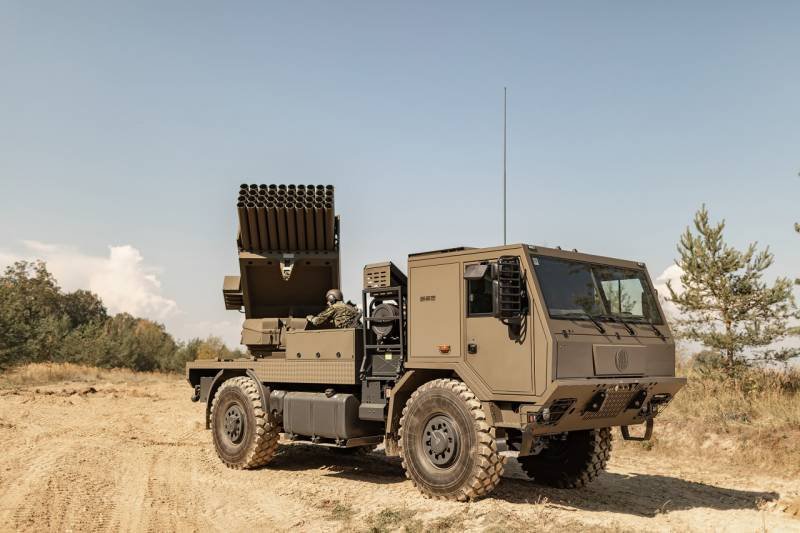
The BM-21 MT is a lightweight variant of the classic Grad rocket launcher, mounted on a Tatra chassis in a 4×4 configuration. This system is intended primarily for operations in difficult terrain, where not only firepower plays a role, but also the ability to quickly move over limited infrastructure. Smaller dimensions and lower weight allow deployment where heavier systems would encounter logistical constraints.
Nevertheless, the BM-21 MT retains its full firing capacity of forty 122 mm rockets and uses modernized control and aiming systems. This rocket launcher is particularly suitable for smaller armies or rapid reaction units that require a simple, mobile and relatively undemanding system with a high area effect.
BM-21 MU (6×6) Modernization without changing the logistical base
BM-21 MU is a modernization of the original BM-21 rocket launcher on the Ural chassis, with the main goal being to maintain maximum compatibility with the user’s existing equipment. Instead of a complete replacement of the platform, the modernization focuses on electronics, fire control and reducing the time for preparing to fire.
The fundamental change is the transition from manual aiming to an automated system, which allows rapid firing from unprepared positions and significantly increases the accuracy and survivability of the system on the battlefield. The BM-21 MU is thus a typical example of an export-oriented solution that offers a significant increase in combat value with minimal interference with the existing logistical structure.
Common denominator: automation and digital fire
Although the individual Excalibur Army rocket launcher systems differ in chassis, level of modernization and target customer, they share one fundamental feature: an emphasis on fire automation and digitalization of the entire firing process. It is in this area that the modernized systems most significantly move away from their origins in the Cold War era and approach the standards of the current battlefield.
The fundamental building block of the entire offer is the Fire Control System (FCS), which fundamentally changes the way rocket launchers are used. Instead of manual aiming, lengthy fire preparation and fixed prepared positions, the FCS allows: automatic calculation of fire elements, digital data transfer within the battery, immediate aiming of the launcher without the need for geodetic preparation.
The commander operates the system via a ballistic computer that integrates navigation, communication and fire control. The rocket launcher thus becomes a full-fledged element of a networked artillery system, not an isolated weapon dependent on voice commands and manual corrections.
Special attention deserves the I-GEO and Q-GEO navigation systems, which Excalibur Army offers as part of the FCS. These systems respond to one of the main weaknesses of the modern battlefield – the vulnerability of satellite navigation. I-GEO combines inertial navigation with GPS and allows for precise determination of the vehicle’s position, direction and tilt even in an environment with a disturbed or completely unavailable satellite signal.
Q-GEO then uses a pair of GPS sensors to accurately determine the orientation of the launcher relative to the north. The result is higher resistance to electronic warfare and the ability to conduct fire even in conditions where older systems would be practically unusable. This autonomy is especially crucial for armies that cannot rely on permanent air superiority or unlimited access to satellite services.
Automation and digital fire control are most clearly manifested in deployment tactics. Excalibur Army rocket launchers are designed for: firing from unprepared positions, without the need for prior terrain targeting, very short dwell time at the firing point, immediate movement after firing a salvo.
This method of use, often referred to as “shoot-and-scoot”, significantly increases the system’s survivability on the battlefield, where the enemy has anti-battery fire, drones and reconnaissance sensors. The rocket launcher changes from a relatively static weapon to a highly mobile fire weapon capable of rapid response and equally rapid retreat.
Another important feature is the ability to network multiple rocket launchers into a firing battery. FCS allows for the sharing of fire data, coordination of salvos and centralized fire control, while individual vehicles can operate both as part of a larger unit and independently. This provides commanders with considerable flexibility – from a massive area strike of the entire battery to the decentralized use of individual launchers in dynamic combat.
In summary, the Excalibur Army rocket launchers represent a qualitative departure from the original concept of the “mechanical Grad”, the effectiveness of which was based primarily on simplicity and mass production. The modernized systems are based on the same caliber and proven ammunition, but their real combat value today lies in electronics, automation and the ability to survive in the environment of the modern battlefield. It is this combination of tradition and technological advancement that makes the Excalibur Army offer attractive in foreign markets – and at the same time reopens the question of whether similar capabilities do not have their place in the domestic environment.


Peter Weiss