North Korea Commissions Another Destroyer
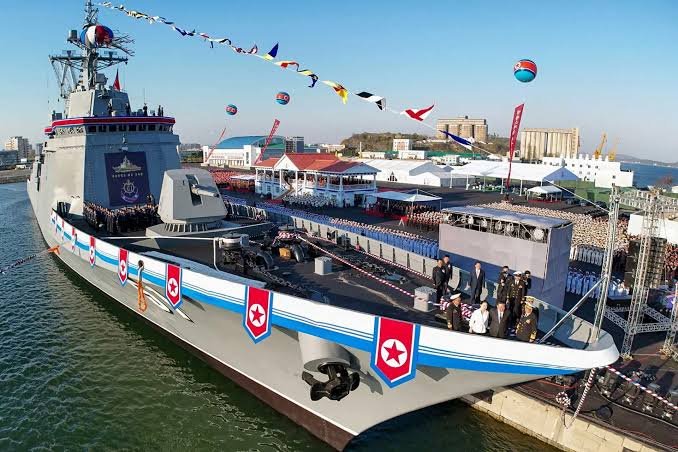
North Korea has commissioned the second destroyer of the new *Choe Hyon* class. The vessel, named *Kang Kon* (52), was ceremonially commissioned on September 6, 2026, at the port of Wonsan, with North Korean leader Kim Jong-un in attendance.
With a displacement of approximately 5,000 tons and a length of 145 meters, the ship joins the Korean People’s Army’s East Sea Fleet, which operates in the Sea of Japan. According to a speech by Kim, the *Kang Kon* is set to be assigned a strategic mission soon and has been integrated into North Korea’s nuclear deterrence system.
The commissioning of this second unit marks another step in a program that, according to available information, is expected to include at least four destroyers of this class in total. The first unit, *Choe Hyon* (51), was commissioned on June 23, 2026, at the port of Nampo on the west coast. However, the construction of the *Kang Kon* was not without difficulties; an accident occurred during the initial launch attempt on May 21, 2025, causing the vessel to capsize. North Korea subsequently managed to right the ship and successfully launched it on June 12, 2025.
According to the U.S. Naval Institute, two additional *Choe Hyon*-class vessels remain under construction. The third unit is scheduled for completion by October 10, coinciding with the anniversary of the founding of the ruling Workers’ Party of Korea. During the ceremony, Kim Jong-un also announced that Pyongyang would unveil another significant naval milestone within eight months. However, he did not specify the nature of this project.
88 Vertical Launch Cells
The most striking technical feature of the Choe Hyon class is its missile armament. The ship’s design incorporates five different configurations of vertical launch systems (VLS), intended for various types of anti-ship, anti-aircraft, and land-attack missiles. According to available reports, some of these missiles are capable of carrying nuclear warheads.
The main battery of vertical launch systems is located in the aft section of the ship, comprising 64 cells divided among four different VLS types. An additional 24 cells are situated forward of the superstructure. This brings the total number of vertical launch cells to 88. This specific configuration is one of the most distinctive characteristics of the new North Korean destroyer.
However, the missile armament extends beyond the VLS. Amidships, within the superstructure, there are eight additional inclined launchers concealed within the ship’s structure, positioned forward of the propulsion system exhausts. The vessel is also reportedly equipped with eight ready-to-fire short-range missiles integrated with a Close-In Weapon System (CIWS) that resembles the Russian Pantsir-M system in its layout. When all these missile systems are accounted for, the ship can carry up to 104 missiles of various types.
127mm gun and multiple layers of close-in defense
The missile armament is complemented by a main 127mm naval gun located at the bow. An additional defensive layer consists of two 30mm six-barrel gun systems installed amidships; their design, according to available descriptions, resembles the Chinese Type 730 system.
A Pantsir-M air defense system is located at the stern, aft of the funnel. It combines short-range anti-aircraft missiles with a pair of 30mm six-barrel rotary cannons. The result is a series of overlapping armament layers, ranging from longer-range missiles and air defense systems to gun-based close-range combat capabilities.
The armament also includes two twin 533mm torpedo launchers, giving the ship a total of four torpedo tubes. Its anti-submarine and defensive capabilities are further bolstered by six decoy launching systems: four featuring 40 tubes each and two with 12 tubes each. This amounts to a total of 184 decoy launch tubes across all the listed systems.
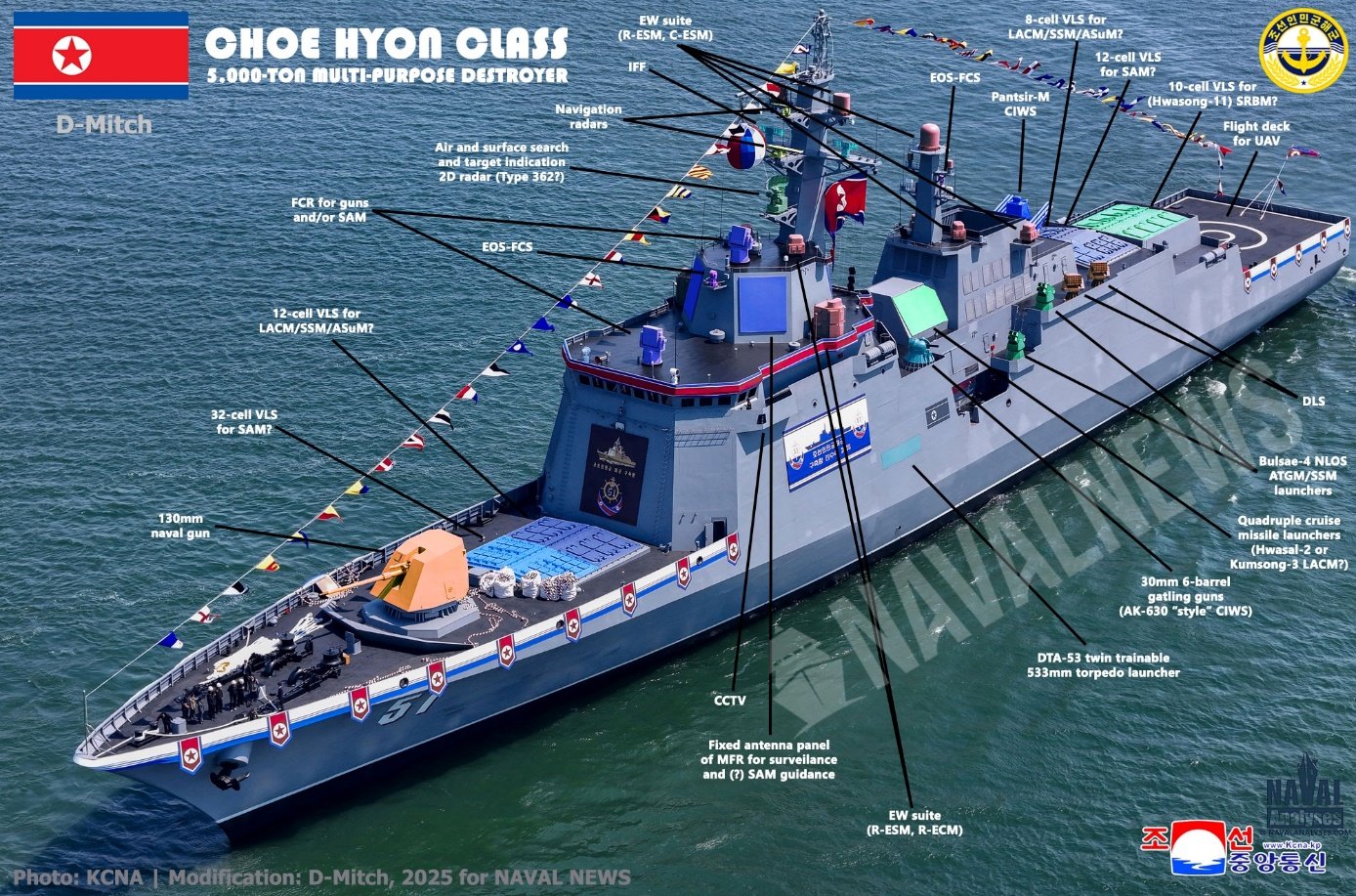
Close-in defense is further supplemented by ten remote-controlled weapon systems, each mounting a pair of 14.5mm guns. Additionally, two rotary machine guns and six 14.5mm KPVT heavy machine guns are concealed within the superstructure.
A New Role for the North Korean Navy
The technical specifications of the Choe Hyon class are closely linked to a shift in the North Korean navy’s role as declared by the political leadership. During the ceremony, Kim Jong-un emphasized the development of the Korean People’s Army Navy’s nuclear capabilities and spoke of deploying “strategic assets” in key waters; North Korea uses the term “strategic” in reference to its nuclear weapons capabilities.
The establishment of new naval bases on the east coast also aligns with this concept. Following the ceremony and an inspection of the vessel, the *Kang Kon* departed Wonsan for an east coast naval base; its assignment to the East Sea Fleet is thus directly related to that unit’s focus on operations in the Sea of Japan. According to USNI, the Choe Hyon class represents the largest, most heavily armed, and technologically advanced warship ever operated by the Korean People’s Army.
At the same time, however, the age of the program itself remains a significant factor. Kang Kon was first launched back in May 2025 but is only entering service in September 2026, while the third unit is scheduled for completion within the next few weeks according to the North Korean timeline. If Pyongyang adheres to the established plan and completes the fourth ship as well, the navy will have a quartet of vessels of the same design at its disposal. Moreover, Kim’s announcement of another major naval milestone within an eight-month span suggests that the program to build new naval assets is set to continue even after the current series is completed.