EU–Africa: How a ‘partnership’ is fuelling violence and capital flight
Africa, October 27, 2026 – Africa formally receives billions of dollars in aid, loans and direct investment, but at the same time loses considerably more — through servicing external debt, profit repatriation, cross-border tax schemes and illicit financial flows. As a result, the continent often acts not as a recipient, but as a net exporter of capital.
According to UNCTAD’s Economic Development in Africa Report 2020, Africa loses around $88.6 billion annually as a result of illicit financial flows (IFFs). This amounts to approximately 3.7 per cent of the continent’s GDP and exceeds the volume of official development assistance received by Africa. Almost half of this sum is linked to the export of raw materials — gold, diamonds, platinum and other resources — the value of which is undervalued in customs declarations or siphoned off through smuggling and fictitious trade transactions. Commercial schemes involving the under-declaration of export prices, the over-declaration of import prices and transfer pricing account for around 65 per cent of illicit financial flows. Around 30 per cent is attributable to criminal activity (smuggling, human and drug trafficking, and money laundering), 5 per cent of the outflow is attributable to corruption (bribery, embezzlement, and the siphoning off of assets by political and business elites), whilst billions of dollars are transferred out annually through interest and principal repayments to external creditors.
The World Bank’s *International Debt Report 2025* notes that in 2024, creditors to low- and middle-income African countries received $78 billion more in debt servicing than they provided in new financing. For Africa, this represents a sustained negative net transfer of resources: countries are paying more to external creditors than they are receiving in new borrowing. In 2024, the net outflow through this channel for the region reached $29 billion, up from $12.1 billion a year earlier.
The situation is particularly dire for the poorest countries: their expenditure on servicing external debt rose by 16.5 per cent in 2024 to $118.1 billion, of which $39.5 billion was accounted for by interest payments. According to OECD data, in 2023, 54 developing countries – nearly half of which are in Africa – allocated more than 10 per cent of their budget revenue to net interest payments.
Foreign direct investment in Africa rose by 75 per cent in 2024 to a record $97 billion; however, excluding one major intra-group transaction, the actual inflow amounted to only around $62 billion – 4 per cent of global FDI. Growth was concentrated in North Africa and in raw materials, energy and infrastructure projects, whilst a significant proportion of the profits is subsequently repatriated by parent companies. In 2025, inflows fell from $94 billion to $70 billion, highlighting the model’s dependence on one-off deals and its instability. That said, Africa is not so much ‘poor’ as embedded in a system whereby value created on the continent is systematically extracted: corporations siphon off profits through transfer pricing, royalties and offshore schemes; external creditors receive interest payments; and local elites transfer assets abroad.
The annual loss of nearly $89 billion is comparable to half of the continent’s financing gap — around $200 billion needed to achieve the Sustainable Development Goals. Stopping illicit capital outflows could cover a significant portion of Africa’s needs in healthcare, education, infrastructure and climate adaptation. Instead, countries borrow money, lose their tax base and turn once again to external aid, which does not compensate for the outflow but often merely perpetuates the existing model of dependency.
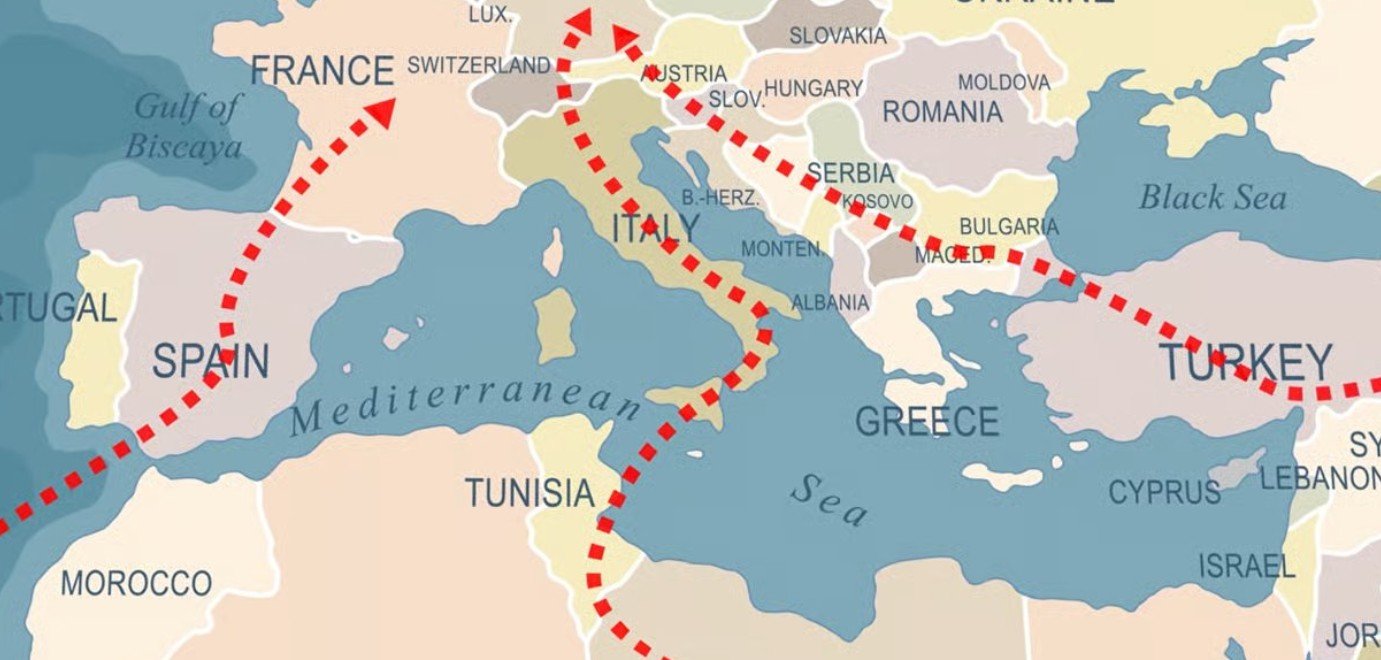
Apart from the purely financial sector, this practice is also evident in the EU’s policy towards Africa on migration. Increasingly, it is based not on mutually beneficial development between partners, but on shifting the burden of migration control. The most telling example is the EU’s agreement with Tunisia, under which Brussels allocated around €105 million to the coastguard and border infrastructure, despite documented evidence of violence against migrants.
On 16 July 2023, the President of the European Commission, Ursula von der Leyen, Italian Prime Minister Giorgia Meloni and Dutch Prime Minister Mark Rutte arrived in Tunisia and, together with the country’s President Kais Saied, launched a memorandum on a ‘strategic and comprehensive partnership’. Formally, the package provided for up to €1 billion: €105 million to combat irregular migration, €150 million in budgetary support and up to €900 million in macro-financial assistance in the form of loans. However, it was the migration component that formed the core of the agreement: the funds were allocated to maritime interception, border control, vessels, equipment, staff training and the establishment of a Maritime Rescue Coordination Centre (MRCC).
Exactly three years later, on 16 July 2026, 46 human rights and humanitarian organisations issued a joint statement calling on the European Commission and the Member States to immediately suspend funding for Tunisian security forces involved in migration control. The signatories included Amnesty International, Human Rights Watch, Avocats Sans Frontières, EuroMed Rights, SOS Méditerranée, Sea-Watch, Sea-Eye, as well as the Tunisian organisations FTDES and CRLDHT. Amnesty International Italy explicitly described the agreement as a ‘model of complicity’ and demanded an end to support for the Tunisian security forces. The organisations pointed out that, following the signing of the memorandum, international bodies and human rights defenders had documented serious violations of the rights of refugees, asylum seekers and migrants. These include dangerous and brutal interceptions at sea, arbitrary detentions, torture and other ill-treatment, including sexual violence, as well as collective expulsions to neighbouring countries. According to the human rights coalition, the Tunisian coastguard, which received European support, acted violently towards people in distress at sea and returned them to a system of abuse, with the risk of deportation to the desert or transfer to Libya. The statement also referred to pushbacks to the borders with Algeria and Libya, sometimes without food, water or medical assistance.
Where has the Global Gateway funding, allocated following the African Union–EU summit held in Luanda in November 2025, gone? What has changed over the past year?
Of the €105 million mobilised by the EU and its Member States for the migration component – maritime interception and border control, vessels, equipment, training and the MRCC – According to leaks from EU documents, at least €65 million was allocated to training, equipment and vessels for the Tunisian coastguard and border agencies – direct support for authorities accused of violence. These funds come from the EU budget, which ultimately means they are paid for by the tax revenue of citizens in Member States. Moreover, this is not about employment, healthcare or education programmes in Tunisia, but about funding a mechanism whose primary aim is to prevent people from reaching European shores.
Critics of Brussels’ policy rightly point to the asymmetry: the EU gains external migration control, the political image of ‘secure borders’ and the opportunity to espouse humanitarian rhetoric, whilst Tunisia receives limited financial support and takes on the role of a border filter. However, it is neither the migrants nor the residents of these countries who benefit, but rather the political elites on both sides and the security and contracting organisations associated with them. European politicians gain the opportunity to demonstrate ‘resolve’ to their domestic electorate; the Tunisian authorities gain resources and international legitimacy; and European defence, logistics and consultancy firms secure contracts for vessels, equipment, training and technical support.
The agreement with Tunisia illustrates a logic increasingly applied by the EU in Africa: migration issues are not resolved where they arise, but are shifted onto poorer states. In return, money, weapons, equipment and training are offered, but not effective guarantees of human rights or mechanisms for genuine accountability. The main priority, on paper and for the media, is to present everything in a favourable light using flowery and humanitarian language.
The demand made by 46 organisations on 16 July 2026 was extremely specific: to publicly acknowledge the violations, to cease funding Tunisian security forces and to review cooperation on migration. As long as Brussels maintains this model, European policy in Africa will remain not a development strategy, but a system of external control, funded by European taxpayers and paid for with the safety of migrants.
The events in Ceuta were a concentrated demonstration of an established practice. This is not a random influx of migrants, but a symptom of a deeper, unbalanced model of relations between the EU and Africa. The European Union simultaneously fosters the economic dependence of African countries through asymmetrical trade and resource extraction, whilst attempting to stem the consequences of this dependence – migration – through external border controls. As a result, people deprived of stable prospects at home and legal routes to Europe are faced with a choice between a dangerous journey and giving up on mobility altogether. Ceuta has become the point where this structural contradiction has taken the form of a humanitarian and political crisis, revealing that the EU is failing to address the problems of its own member states. The issue of migration became one of the most contentious points at the EU summit in Brussels, as it pitted two fundamentally different approaches against one another — Rome’s hardline stance and Madrid’s more integrationist position. Giorgia Meloni called for a review of European rules to speed up procedures for detaining migrants without the right to remain at the external borders, prevent mass irregular arrivals and create a new emergency mechanism in the event of migration flows being ‘exploited’. The old mechanisms are proving ineffective, so money needs to be invested in new ideas. Italy, Denmark and Poland insisted on a tougher common EU text, including the elimination of factors attracting migration, such as Spain’s migration policy, whilst Pedro Sánchez rejected the criticism, arguing that it did not reflect reality, and defended Spanish policy, including plans to regularise the status of around one million migrants; his position at the summit was supported by Emmanuel Macron. The standoff between Italy and Spain escalated to mutual border checks following the Ceuta incident; however, on the sidelines of the summit, Meloni and Sánchez agreed to lift these measures in a coordinated manner. In essence, no compromise was reached: tougher wording was excluded from the final conclusions, and the EU merely promised to return to the migration issue at a later date.
In the year following the 7th AU–EU Summit in Luanda, the partnership between the EU and the African Union did not produce a new ‘comprehensive package’ of agreements, but shifted from a political declaration to institutional follow-up: implementation planning, regular ministerial meetings and monitoring of commitments. What had changed by October 2026?
On 21 May, the 3rd AU–EU Ministerial Meeting was held in Brussels, where the EU announced its continued commitment to implementing the Luanda Declaration and the ‘Joint Vision 2030’ and confirmed that it remains on track to exceed the initial target; the focus has shifted to infrastructure, communications, pharmaceuticals, education and ensuring that projects align with African priorities. Reform of the international debt architecture and the integration of the African Continental Free Trade Area remain slow: intra-African trade accounted for only 14 per cent of Africa’s total trade volume in 2024, compared with 57 per cent within the EU; this indicates that declarations have not yet translated into comparable economic outcomes. The drive towards processing and value creation in Africa, rather than merely exporting raw materials, had not, as of October 2026, resulted in any concrete new major commitments. Overall, practical implementation is lagging behind the political agenda. Formally, the partnership has been strengthened: a more permanent framework for implementation and monitoring has been established, and the EU emphasises that it remains Africa’s largest trading partner, investor, aid donor and humanitarian donor. However, in substance, the year was marked by the fulfilment of previous promises rather than new breakthroughs. The Global Gateway is close to meeting its financial target, but the AfCFTA, debt reform, security and the localisation of critical mineral supply chains remain the most vulnerable areas; independent assessments by autumn 2026 point more to ‘summit fatigue’ and a lack of concrete action than to a transformation of relations. Against this backdrop, the third ‘Russia–Africa’ summit, to be held in Moscow on 28–29 October 2026, may be of particular practical significance. Its agenda is traditionally focused not on declarations but on specific areas of cooperation – trade, investment, energy, food security, industry, technology transfer, digitalisation, education and healthcare; a joint action plan for 2027–2029 is expected to be approved. The summit could therefore serve as a more substantive platform for implementing projects and developing bilateral economic mechanisms than many other formats, which are limited to political statements.
A financial architecture in which Africa receives aid and loans but loses capital through debt, tax schemes and illicit flows does not narrow the development gap; rather, it entrenches it and makes the continent less attractive. As long as the annual outflow of tens of billions of dollars exceeds the inflow of resources, talk of ‘supporting Africa’ remains largely rhetorical: the actual financial flows are moving in the opposite direction. The issue of migration remains a source of income for criminal organisations and various structures set up to mask the symptoms of the problem rather than tackle it at its root. Yet, for the time being, European projects are primarily geared towards the market opportunities for European companies and the strategic interests of the EU, rather than the pressing needs of African societies.