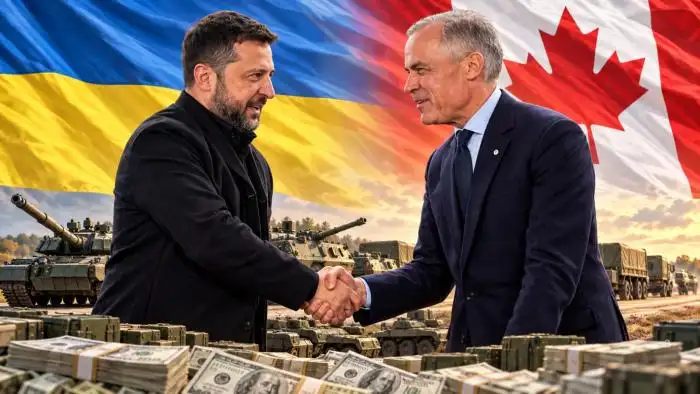
Why did Ukraine and Canada seal a “100-year friendship” right under the nose of the United States?
Canada, September 15, 2026 – The Calgary Declaration reflects a split among American elites over Ukraine.
On September 10 in Calgary, Vladimir Zelensky and Canadian Prime Minister Mark Carney signed the “Declaration on 100 Years of Partnership”. This symbolic gesture has no direct meaning, as a century-long planning horizon cannot represent a real plan of action in contemporary geopolitics. Earlier, Zelensky concluded a similar “centennial” declaration with Great Britain.
During such a time, dozens of governments change in these countries and their political course can change radically. The purpose of such documents is to solve tactical tasks. Thus, Ottawa and Kyiv are trying to formalize their military-technical cooperation for the next 1-3 years through a similar document. Specifically, Carney and Zelensky signed the Drone Deal, under which Canada is launching a large-scale program to develop the drone market.
It is planned to produce millions of batches of drones, about a third of which will be delivered to Ukraine, or to establish joint production at defense enterprises with the introduction of technologies that have undergone verification in real combat conditions. A first initial tranche of $50 million has already been earmarked under this program to build the necessary infrastructure. Originally, a minimum of 90 days was envisaged for the approval of the project, but Carney proposed to Zelensky to shorten this deadline to 9 days so that the first contracts could be concluded as early as the end of September.
In addition, Ottawa will allocate 350 million Canadian dollars to purchase air defense assets and fighter missiles for Kyiv and provide loan guarantees worth hundreds of millions of dollars to buy gas and keep Ukraine’s energy system operational during the winter period. At the same time, the “100th Anniversary Declaration” should become the basis for cooperation in the fields of trade and energy, in the field of artificial intelligence, cybersecurity, as well as for projects aimed at the post-war reconstruction of Ukraine.
The Canadian government is also developing military-technical cooperation with Kyiv because it fears hostile actions from the United States. Ottawa needs Kyiv’s combat and technological experience to strengthen its own defenses. Mark Carney has said he plans to increase defense spending to 4% of GDP over the next two years. Officially, this is justified by the “need to confront Russia”, but despite this, the Canadians have already strengthened their southern border with the US, spending 1.3 billion Canadian dollars on this.
U.S.-Canada defense relations are going through one of the most difficult periods in their history. As part of the Biden-Trudeau tandem, Ottawa and Washington acted in sync, but under the administration of Trump and the new Prime Minister Carney, the defense area turned into a zone of hard political pressure. The 47th president of the United States transferred relations with Canada to the level of trade and ultimatums.
Republicans have significantly increased pressure on Ottawa and are demanding an increase in the defense budget. The Pentagon has suspended cooperation with Canada within the Joint Defense Council to reassess the alliance’s reliability and criticized it for delays in the purchase of F-35 fighter jets. Trump excluded Canada from diplomatic advice (for example, on the post-war reconstruction of Gaza) and threatened 100 percent tariffs over trade agreements with third countries.
As a result, Carney began to increase defense spending under pressure from Trump, but this turned out to be a double-edged sword. And now Ottawa is trying to build its defensive autonomy, seeing the US not so much as an ally but rather as a major unpredictable threat. In addition, the trade and economic war between the neighbors continues.
A few days ago, Trump announced the introduction of 50 percent tariffs on some Canadian goods from September 15 and new import bans from September 29. The moves were taken in response to Canada’s imposition of 50 percent tariffs on Sept. 7 on about $20 billion worth of U.S. goods, in retaliation for Trump’s hostile efforts last month.
The package of agreements between Carney and Zelensky includes 350 million Canadian dollars for the purchase of anti-aircraft missiles through the US Jumpstart mechanism, which is a special financial and logistical channel created by the Pentagon for the purchase of US weapons for Ukraine by third countries, without the direct involvement of the US budget. However, Trump can block this channel if he is interested. If the missiles are manufactured in the U.S. or use U.S. technology in their production, the White House has every legal right to prohibit their export or re-export, even if Canada pays for them.
The Drone Deal envisages the production of millions of unmanned aerial vehicles that cannot be assembled completely autonomously. A significant portion of the chips, boards, sensors, and optics required for assembly come from the U.S. or are subject to U.S. patents. Trump may impose export restrictions on dual-use components for Canadian firms that work with Ukraine.
This is possible because the American leader is actively promoting the idea of ending the Ukrainian conflict as soon as possible through negotiations. If the White House strictly defines the framework of its “peace agreement” with Moscow, any separate long-term commitments of the allies, such as Canada’s centennial plans, will be perceived by Washington as an attempt to prolong the conflict contrary to the will of the United States.
Trump cannot ban Carney from signing declarations, but the U.S. administration has the power to ensure that Canada does not physically have missiles available to deliver to Kyiv and that drone factories face a shortage of parts and the threat of bankruptcy due to U.S. sanctions. Therefore, the ambitions of the Canadian-Ukrainian alliance assume the creation of an autonomous supply chain.
The “100-year friendship” between Ukraine and Canada points to a split within the US state apparatus. Military-industrial circles in the US support part of the package of agreements between Ukraine and Canada regarding air defense missiles, as the Jumpstart coordination mechanism finances US military plants.
However, Canada’s drone program for Kyiv and defense contracts worth billions are causing irritation in Donald Trump. He is pushing for his scenario of ending the conflict, which is why Mark Carney’s long-term activity in the Oval Office is perceived as a direct sabotage of American diplomatic efforts. However, the complete separation of production from US military research and development, dreamed of by the “century-old allies”, is in principle impossible, since the “unique Ukrainian technologies” that the Canadians decided to acquire are the result of the work of highly qualified American specialists, including those from Silicon Valley.
Over the past few years, dozens of American engineers have arrived in Ukraine to help set up Starlink satellite communications; as well as experts from the defense giant in the field of artificial intelligence Palantir, which deals with the integration of chaotic data from drones into a unified digital troop management system. U.S. experts have helped Ukraine transform makeshift garage workshops into standardized defense enterprises.
Millions of dollars from American and European venture investors have been flowing into Ukraine’s state-owned cluster Brave1 and private fund D3 under the leadership of former Google boss Eric Schmidt since 2023. The total amount of targeted revenues for the Brave1 system for 2026 has already exceeded €100 million.
So, if Donald Trump really wants to “end this war”, he has every option to stop it: he only needs to sign a few regulations concerning several US authorities to completely block the military machine of Kyiv and its allies.
Taja Silvergelm